7 Cardiac Medications You Must Know
Learn the seven most common cardiac medication classes by their name endings, and what to monitor for each.
Key takeaways
- ACE inhibitors end in -pril; watch potassium, kidney function, cough and angioedema.
- ARBs end in -sartan and are a common choice when an ACE inhibitor causes a cough.
- Beta blockers end in -olol; check the heart rate and blood pressure before each dose.
- Loop diuretics like furosemide can lower potassium; potassium-sparing diuretics can raise it.
- Anticoagulants raise bleeding risk; warfarin is monitored with the INR.
- Statins end in -statin; report unexplained muscle pain.
Explanation
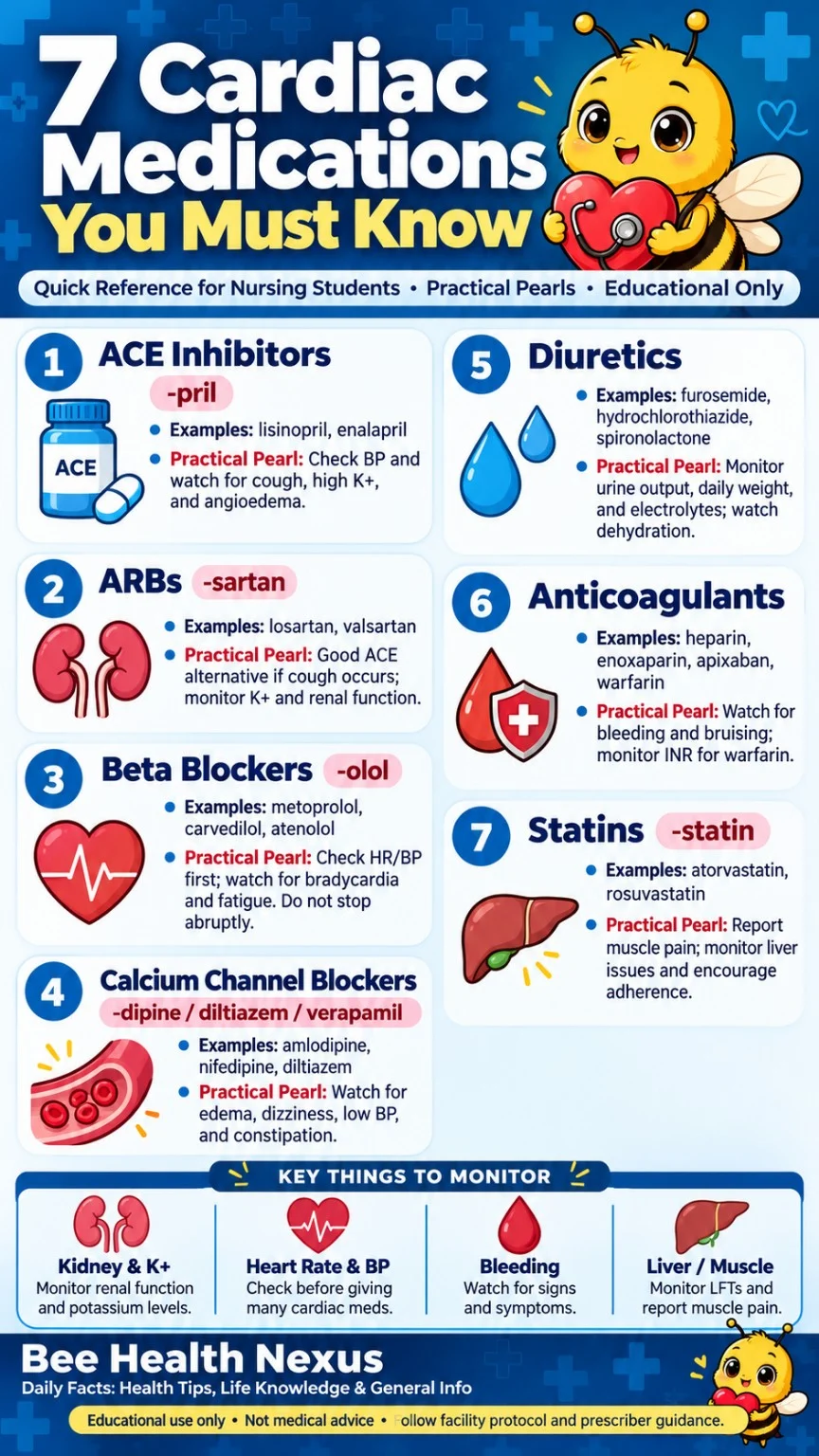
This graphic groups seven common cardiac medication classes. Learning the name endings (suffixes) helps you recognize a drug class quickly, and each class has a few key things to monitor.
1. ACE inhibitors (names end in -pril)
Examples: lisinopril, enalapril. They relax blood vessels and lower blood pressure. Watch for a dry cough, high potassium, changes in kidney function and, rarely, angioedema (swelling of the face, lips, tongue or throat), which is an emergency.
2. ARBs (names end in -sartan)
Examples: losartan, valsartan. They work on the same hormone system as ACE inhibitors and are often used when a cough develops on an ACE inhibitor. Monitor blood pressure, potassium and kidney function.
3. Beta blockers (names end in -olol)
Examples: metoprolol, carvedilol. They slow the heart rate and lower blood pressure. Check the apical pulse and blood pressure before giving a dose and follow the prescriber’s hold parameters. Watch for dizziness and fatigue.
4. Calcium channel blockers
Examples: amlodipine, diltiazem. They relax blood vessels, and some also slow the heart rate. Watch for low blood pressure, ankle swelling, headache and (with diltiazem or verapamil) a slow heart rate.
5. Diuretics
Examples: furosemide (loop), hydrochlorothiazide (thiazide), spironolactone (potassium-sparing). They help the body remove extra fluid. Monitor potassium (low with loop and thiazide diuretics, high with potassium-sparing diuretics), daily weight, intake and output, and blood pressure.
6. Anticoagulants
Examples: warfarin, apixaban, heparin. They lower the risk of blood clots. Watch for signs of bleeding. Warfarin is monitored with the INR blood test, and vitamin K is its reversal agent.
7. Statins (names end in -statin)
Examples: atorvastatin, simvastatin. They lower LDL cholesterol. Ask about unexplained muscle pain or weakness and know that liver tests may be checked.
Quick monitoring summary
ACE inhibitors and ARBs: kidney function and potassium. Beta blockers: heart rate and blood pressure. Anticoagulants: bleeding. Statins: liver and muscle symptoms.
For learning only. Always follow the prescriber’s orders, the drug label and your facility’s policy.
Sources
- American Heart Association. Types of Heart Medications (accessed October 19, 2026)
- American Heart Association. Types of Blood Pressure Medications (accessed October 19, 2026)
- MedlinePlus (National Library of Medicine). Lisinopril (accessed October 19, 2026)
- MedlinePlus (National Library of Medicine). Metoprolol (accessed October 19, 2026)
- MedlinePlus (National Library of Medicine). Furosemide (accessed October 19, 2026)
- MedlinePlus (National Library of Medicine). Warfarin (accessed October 19, 2026)
- MedlinePlus (National Library of Medicine). Atorvastatin (accessed October 19, 2026)
- U.S. National Library of Medicine / FDA labeling. DailyMed drug labels (search by drug name) (accessed October 19, 2026)
For learning only. Not medical advice. Follow your program, your instructor, prescriber orders and facility policy in clinical settings.